
The 10 best job vacancy tips to recruit new volunteers
The 10 best job vacancy tips to recruit new volunteers
Sound familiar? You open a job board, read it, and after 10 seconds, you're so dizzy from the extensive job requirements, jargon, expectations, and promises that you can't (or don't want to) find the "apply" button. There are over 22.000 open positions in the volunteer sector – so it's even more important that you get potential volunteers curious and motivated to contact you. How do you avoid scaring off new volunteers? Avoiding buzzwords, jargon, and the job title goes a long way.
Reading time: 6 minutes
Labor market competition times ten
As passionate volunteer matchmakers, we see thousands of volunteer vacancies and requests every day. Literally: there are currently thousands of volunteer opportunities live. If you're looking for a helping hand (or other beautifully expressed parts of your body like a thoughtful mind or a warm heart), you're venturing into the most competitive market in the Netherlands. For comparison: in this thriving job market with more jobs than ever before, the larger job boards appear to have an average of around 2.500 vacancies. A tenfold difference compared to volunteer vacancies!
Creativity required
So you'd think the creativity in recruiting volunteers would be overwhelming. How else are you going to stand out while scrolling through job postings? Or hold the reader's attention for more than three seconds? Otherwise, you won't even get a chance to tell them how you're making the world a little more beautiful...
But no—not really. Scrolling through the 22.000+ vacancies on NLvoorelkaar, you'll quickly conclude that creativity is hard to come by. Creativity, however, is requested over 1.200 times, so perhaps it's not surprising that it's a bit lacking right now ;-).
Scare
Besides a lack of creativity, some of the texts seem almost designed to avoid finding new volunteers. Generic texts and job posting numbers, jargon that makes you feel like an old man, and minimal participation requirements that require you to have no work or social life. Personality profile requirements aimed at the perfect person—which doesn't exist—thus scaring off the average person with their own lives and shortcomings. A shame. Because the whole point of a volunteer posting is to connect with each other. And then figure out together if you can make a difference.
The 10 best tips
For anyone looking for volunteers through a volunteer vacancy, we've compiled the 10 best tips. How do you stand out from the crowd? How do you find new volunteers to fill that fresh air? Read on and let us know your tips!
1. Title and photo
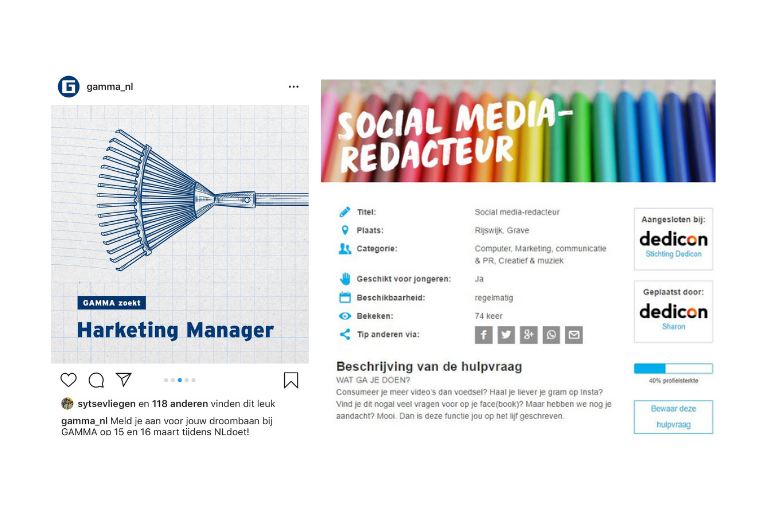
Create a concise, engaging title that makes readers want to keep reading. The title is often the only thing a job board or search engine displays. Our favorites: "Harketing Manager Wanted" or "Bus Driver Wanted" (source: Gamma for NLdoet).
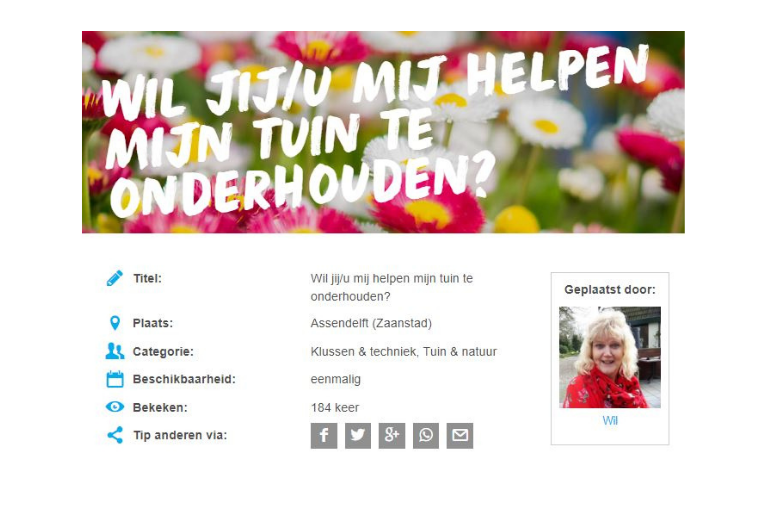
The same goes for photos. Yes, a logo is nice and easy and clear, but also rather boring. So dare to go for something personal, funny, or unique. Like this woman, whose great photo gets many more comments.
2. humor
A positive way to stand out is with humor. Think of the 'Harketing manager' instead of a gardener for your client. Or describe the activities with a wink, for example, 'Do you consume more videos than food, or do you find this too much on your face(book)?' ( Dedicon)
3. Avoid clichés
Are you also looking for a flexible, enterprising, enthusiastic, and communicative volunteer full of passion? Oops – there are about 10.311 (yes, really!) others like you. So you don't stand out.
And have you ever wondered what that does to the reader – the potential volunteer? When the word 'flexible' appears in a standard job description, everyone knows the employer is referring to overtime. I have never met a person who lacks communication skills (we can all talk and gesture), we prefer to do business *with* a financial reward, and passion is best kept for the bedroom. You can read more words you would rather not use in your volunteer vacancy here.
Prevent itching. Clearly explain what you expect from the other person. The easiest trick for this: pretend you're talking to a friend or family member!
4. Avoid jargon
This one is similar to the previous one: do you have an affinity for clients with moderate intellectual disabilities? Or are you more interested in mild intellectual disabilities? Vascular dementia? Autism spectrum disorder? Or experience with benzodiazepine withdrawal? These are just a few examples of the jargon used in the volunteer positions currently available.
Even with my master's degree in psychology, I'm tempted to click away screaming and enjoy... something else, anything. I already have a job, so I don't have time for scary illnesses (or looking up what that jargon actually means).
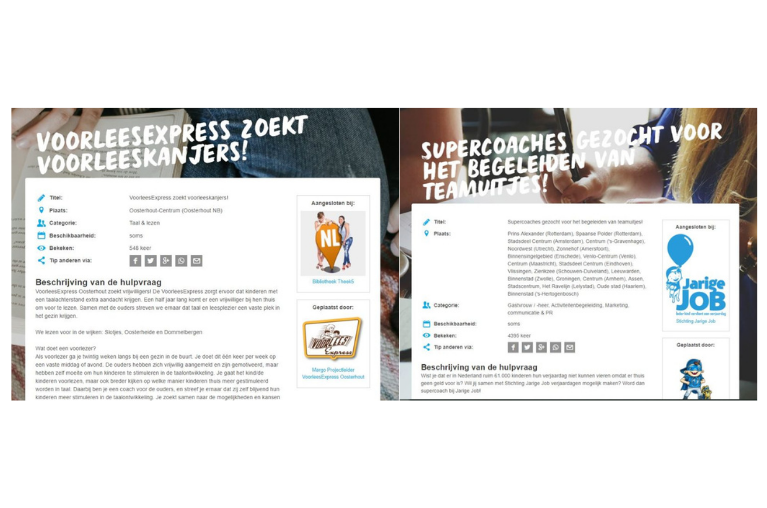
Top tip: keep it simple. And above all, human. Not a client, a patient with a serious illness, or Mrs. P looking for a free driver or gardener, but someone's grandpa/Ana who loves playing cards but can't roll over to her friend/Liv who, within two years, is almost fluent in Dutch/would be very happy if you helped out with... (fill in the blank). Good examples are the Jarige Job Foundation and the VoorleesExpress.
5. Mission
The mission (or impact – sorry for that buzzword) is often missing. Why would a volunteer sacrifice their valuable free time? It seems like a cliché, but it's forgotten in more than half of all texts!
Briefly mention the mission/impact at the top of your text. People read from top to bottom, and the first few lines of a volunteer posting are often shown in search results (on Google, NLvoorelkaar, etc.). Besides a statement (e.g., "Together we make sure every child can celebrate their birthday"), you can also consider impressive results (e.g., "Already helped 10.000 people"). Or keep it short with a meaningful quote about what the help has meant to someone.
6. Benefits: What's in it for them?
Write your recruitment text with a volunteer's perspective. What's in it for them? Better yet, ask a current volunteer. It'll instantly become more credible, because the WCeend team always considers WCeend the best and most fun.
Make sure your language, sentence structure, and offer are relevant to the volunteer you're looking for. Describe/ask/think about/Google the benefits of your volunteer work. Is walking with your seniors an impressive, mindful experience? Do you have the best coffee? The most friendly team? Or do you regularly laugh out loud at the tall tales or bold actions of your seniors? Share what you're proud of!
7. Demanding instead of asking politely
Job requirements is a word that belongs in regular job postings – and even evokes nostalgic 90s feelings in recruiters. And yet, it is currently used in 21% of volunteer vacancies (4.130 of them!). But the term 'volunteers' actually says it all. Requirements do not belong here.
So what? We challenge you to rethink: for example, go from requirement to ice cream... literally! That idea earned us 163 new volunteers for one vacancy. In this case, Ben & Jerry's actually provided ice cream, so it's definitely cheating a bit. But consider the talent everyone has and the time they're willing to donate to you. See if you click with someone and what makes them happy. You can probably find a creative outlet for that. And if not, your interviewer might know someone else. Recruiting through word of mouth is still the most successful recruitment method.
Would you like to have your free time committed to an unknown person, for an unknown purpose and with an unknown result for the coming year?
8. Short (enough)
Keep it short. Who has the time and inclination to wade through a whole A4 page of job descriptions, Certificates of Conduct (what? hello jargon!), compensation structures (only needed to know *that* they exist or not), volunteer contracts (yuck, mandatory!), or schedules? Job advertisements are a kind of elevator pitch: you have to be able to make someone wildly enthusiastic within a minute. Incidentally, that also means it shouldn't be too short; it's hard to get excited about something vague or unclear.
Once you've established contact, there's plenty of time to discuss preconditions and content. Think of applying for a job: you only discuss these kinds of things once you've met and clicked!
9. Non-binding and accessible
Whatever kind of amazing person you are, would you want to have your free time committed to an unknown person, for an unknown purpose, and with an unknown outcome for the coming year?
I don't. So make it easy to start doing something good. Of course, you want a volunteer who's there for four hours a week (or even more). But that kind of dedication has to grow. You have to like each other and both enjoy it. So offer introductory activities as well.
This can be very practical: an activity where you can always have extra people join you, in addition to your current volunteers. Or organize a meetup once a month where you can speed date with other volunteers and the coordinator. And think about a suitable time, because Tuesday morning might be easy for you, but for 60% of people, it's the busiest day of the week ;-).
Organizing differently also saves a lot of introductory meetings and is much more enjoyable. Because that's one of the main reasons people seem to volunteer (for example, research from NLvoorelkaar shows that 43% of volunteers want to meet new people).
10. Cherish
Finally: cherish and keep doing what works. Don't change for the sake of change. Cherish your volunteers. Share your positive experiences with others (like us) so we can continue to learn from each other. And perhaps you'd enjoy experimenting creatively with one of the tips in this article. A little variety and diversity is always refreshing, because if you do what you did, you get what you got.
Want to know more?
Looking for the smartest and most engaging way to make a difference for your municipality or organization? Questions, ideas, a short demo, or exploring the possibilities together? Schedule a digital coffee with us!