
Community-oriented work: how to make the social foundation visible and accessible
Mrs. De Vries has lived on the same street for 34 years. Her children live far away. She has difficulty walking, but asks no one for help. Not because she does not need support, but because she does not want to be a burden to anyone.
Arianne lives three streets away. She is 42, has a busy job and two children. She would really like to do something for someone in her neighborhood. But she doesn't know who needs help and how to find them.
The will is there. The infrastructure is often still lacking.
These two residents could mean something to each other. Yet they do not find each other naturally. Not because the will is lacking, but because the infrastructure to find each other is not always in place.
Double aging, healthcare shortages, and growing loneliness make it increasingly important that residents can find and support one another. A strong social foundation, greater social cohesion, active resident participation, and better collaboration in the neighborhood are therefore high on the agenda for many municipalities.
Neighborhood-oriented work gives concrete form to this: it ensures that residents, organizations, and initiatives can actually find and strengthen each other.
From separate initiatives to one local network
A lot is already happening in every neighborhood. There are volunteers, residents' initiatives, activities, and organizations that offer support. However, this information is often scattered across various websites, calendars, and systems. As a result, residents find it more difficult to find what they are looking for, requests for help go unanswered, and available resources are not fully utilized. Moreover, for organizations, this fragmentation makes it harder to maintain an overview and collaborate in a targeted manner.
A good local infrastructure makes what is already there easier to find and brings together demand, supply, activities, and engaged residents.
To help municipalities and welfare organizations with this, we developed Buurtgericht Werken : our digital solution for locally connecting residents, organizations, and initiatives.
A digital place for everything happening in the neighborhood
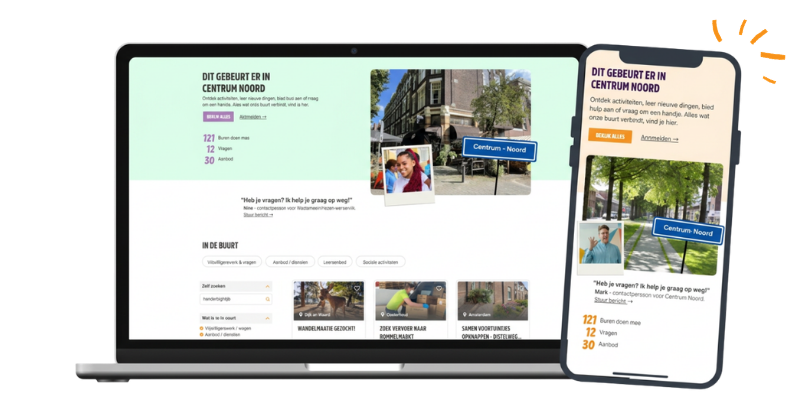
Neighborhood-Oriented Working is a digital environment for a district, neighborhood, or other local area. Residents, social organizations, and initiatives come together there.
Residents can, for example:
- ask neighbors a question;
- indicate how they can help someone else;
- discovering activities in their neighborhood;
- take or offer a course;
- find local initiatives;
- get in touch with organizations active in the neighborhood.
Organizations can also make their activities, volunteer vacancies, and other forms of support visible. This creates a single recognizable place for neighborly help, volunteering, activities, residents' initiatives, and local support . As a result, residents can more easily find out what is happening in their neighborhood and where they can participate or find help. At the same time, municipalities and neighborhood organizations gain a better overview of what is happening in various neighborhoods.
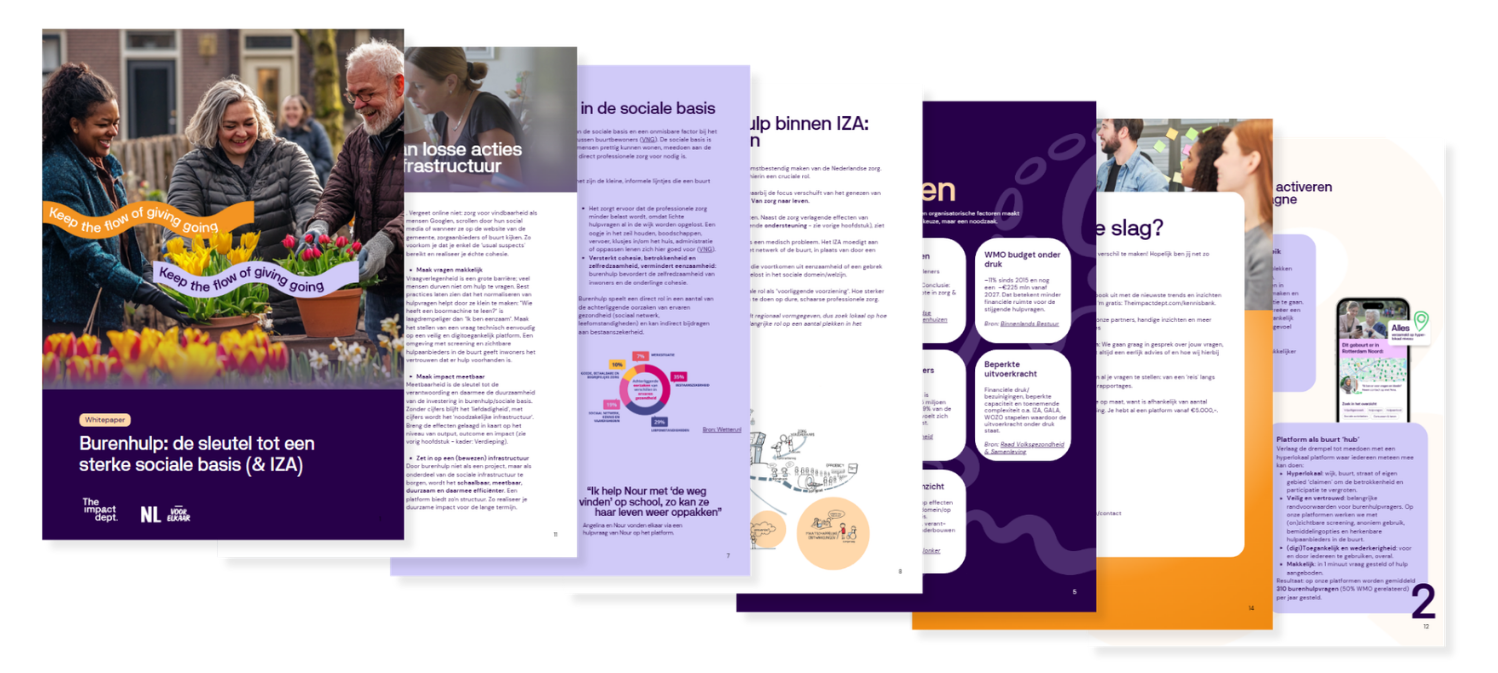
Neighbourly help: the key to a strong social foundation (& IZA)
Discover how neighborhood assistance reduces pressure on Wmo budgets and aligns with the IZA. This white paper offers a practical approach to activating residents via a hyper-local platform, including calculation examples of cost savings, effective nudges, and measurable practical results.
What else our platform offers
Safety and trust as the foundation
A digital environment where residents connect requires trust. Therefore, within Buurtgericht Werken, requests, offers, messages, and participants are screened daily in compliance with GDPR regulations. There is also a helpdesk where participants can turn with questions or after an unpleasant experience. A local infrastructure only works if residents can trust that their data is handled carefully and that action is taken when necessary.
View of what is happening in the neighborhood
Neighborhood-oriented work also requires insight into the results of the approach. Neighborhood-Oriented Working automatically makes results visible in a dashboard: from reach and connections to hours of effort and developments per neighborhood or theme. This allows municipalities and welfare organizations to see not only what is happening but also where opportunities lie to make adjustments. Additionally, we map the societal effects with an impact analysis.
Community-oriented work begins with the right infrastructure.
Neighborhood-oriented work only gains value when residents and local organizations truly know how to find each other. This requires a local infrastructure that brings together supply, demand, and activities simply, safely, and clearly. Neighborhood-Oriented Working provides that infrastructure and helps to make neighborhood policy ambitions concrete.
Want to know more?
Looking for the smartest and most engaging way to make a difference for your municipality or organization? Questions, ideas, a short demo, or exploring the possibilities together? Schedule a digital coffee with us!