alt="">

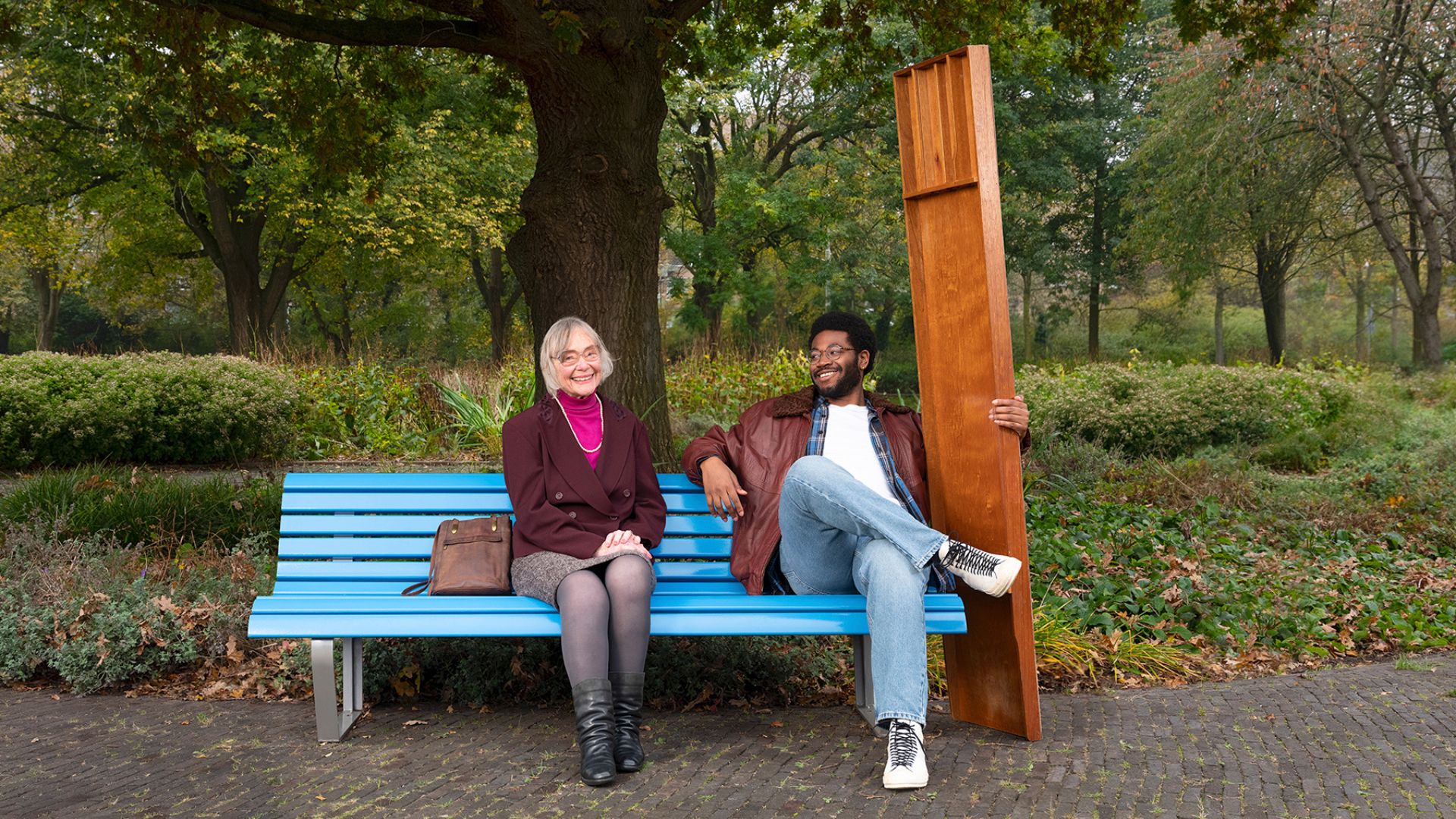
Mrs. De Vries has lived on the same street for 34 years. Her children live far away. She has difficulty walking, but asks no one for help. Not because she does not need support, but because she does not want to be a burden to anyone.

Arianne lives three streets away. She is 42, has a busy job and two children. She would really like to do something for someone in her neighborhood. But she doesn't know who needs help and how to find them.

The will is there. The infrastructure is often still lacking.

These two residents could mean something to each other. Yet they do not find each other naturally. Not because the will is lacking, but because the infrastructure to find each other is not always in place.

Double aging, healthcare shortages, and growing loneliness make it increasingly important that residents can find and support one another. A strong social foundation, greater social cohesion, active resident participation, and better collaboration in the neighborhood are therefore high on the agenda for many municipalities.

Neighborhood-oriented work gives concrete form to this: it ensures that residents, organizations, and initiatives can actually find and strengthen each other. 

From separate initiatives to one local network

A lot is already happening in every neighborhood. There are volunteers, residents' initiatives, activities, and organizations that offer support. However, this information is often scattered across various websites, calendars, and systems. As a result, residents find it more difficult to find what they are looking for, requests for help go unanswered, and available resources are not fully utilized. Moreover, for organizations, this fragmentation makes it harder to maintain an overview and collaborate in a targeted manner. 

A good local infrastructure makes what is already there easier to find and brings together demand, supply, activities, and engaged residents.

To help municipalities and welfare organizations with this, we developed Buurtgericht Werken : our digital solution for locally connecting residents, organizations, and initiatives.

Anchor: Our solution: Community-oriented Working
0 %
has met new people through the platform.
0 %
feels more connected to their own district or neighborhood.
0 %
has started helping others.

A digital place for everything happening in the neighborhood

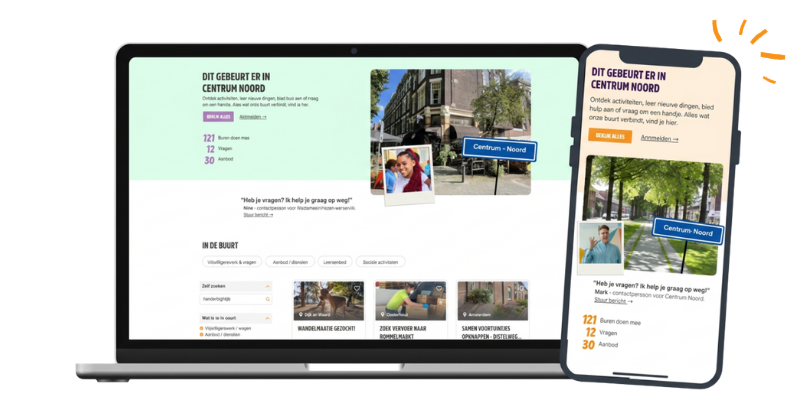
Neighborhood-Oriented Working is a digital environment for a district, neighborhood, or other local area. Residents, social organizations, and initiatives come together there.


Residents can, for example:

  • ask neighbors a question;
  • indicate how they can help someone else;
  • discovering activities in their neighborhood;
  • take or offer a course;
  • find local initiatives;
  • get in touch with organizations active in the neighborhood.

Organizations can also make their activities, volunteer vacancies, and other forms of support visible. This creates a single recognizable place for neighborly help, volunteering, activities, residents' initiatives, and local support . As a result, residents can more easily find out what is happening in their neighborhood and where they can participate or find help. At the same time, municipalities and neighborhood organizations gain a better overview of what is happening in various neighborhoods.

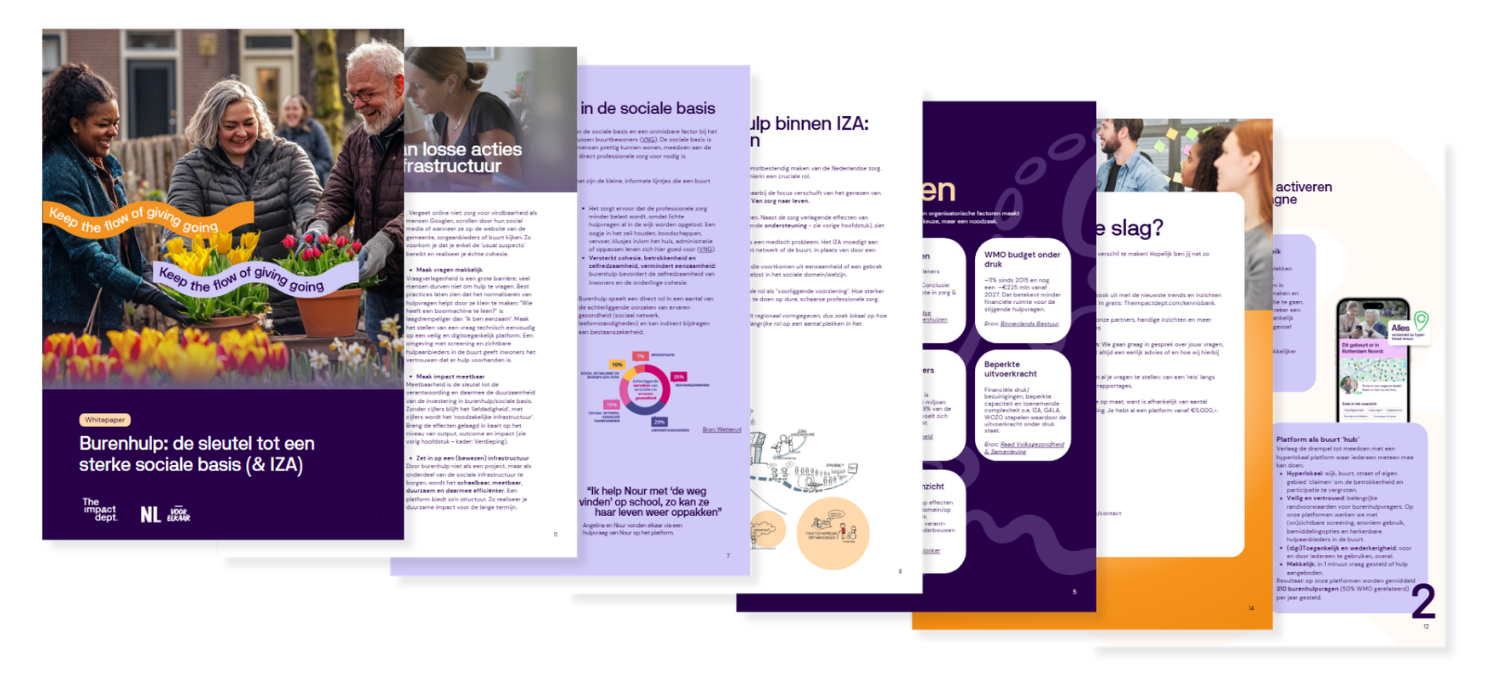
Neighbourly help: the key to a strong social foundation (& IZA)

Discover how neighborhood assistance reduces pressure on Wmo budgets and aligns with the IZA. This white paper offers a practical approach to activating residents via a hyper-local platform, including calculation examples of cost savings, effective nudges, and measurable practical results.

Read it here

What else our platform offers

Safety and trust as the foundation

A digital environment where residents connect requires trust. Therefore, within Buurtgericht Werken, requests, offers, messages, and participants are screened daily in compliance with GDPR regulations. There is also a helpdesk where participants can turn with questions or after an unpleasant experience. A local infrastructure only works if residents can trust that their data is handled carefully and that action is taken when necessary.

View of what is happening in the neighborhood

Neighborhood-oriented work also requires insight into the results of the approach. Neighborhood-Oriented Working automatically makes results visible in a dashboard: from reach and connections to hours of effort and developments per neighborhood or theme. This allows municipalities and welfare organizations to see not only what is happening but also where opportunities lie to make adjustments. Additionally, we map the societal effects with an impact analysis.

Community-oriented work begins with the right infrastructure.

Neighborhood-oriented work only gains value when residents and local organizations truly know how to find each other. This requires a local infrastructure that brings together supply, demand, and activities simply, safely, and clearly. Neighborhood-Oriented Working provides that infrastructure and helps to make neighborhood policy ambitions concrete.

Want to know more?

Looking for the smartest and most engaging way to make a difference for your municipality or organization? Questions, ideas, a short demo, or exploring the possibilities together? Schedule a digital coffee with us!

Coffee plans →


Sponsorring award won!

Hooray! The Volksbank x NLvoorelkaar campaign "Stronger Together for Volunteering" has won the bronze SponsorRing award!

Anchor: Case & goal

Case and purpose

As part of its "better for each other" promise, De Volksbank is sponsoring the NLvoorelkaar volunteer platform. This is one of the ways the bank, as a socially responsible bank, is investing in a better Netherlands, both with euros and with volunteer hours. De Volksbank's 3.5000 employees are encouraged to contribute to their own NLvoorelkaar impact platform during working hours. Furthermore, the initiative has encouraged everyone in the Netherlands to participate by demonstrating how accessible and enjoyable volunteering can be.
Broadcast commercial 'Strong together for volunteer work':

Anchor: Result

Result

The campaign period led to the greatest impact ever measured, with an average 60% increase in matches compared to the previous year. In total, the collaboration generated over 72.000 additional volunteer hours, representing a social value of €1,5 million.

We love creating a win-win situation in our collaborations. Besides the hours, the impact:

  • We learned a lot about ATL campaigns, tell-and-sell tactics, hyper-local social ads—in short, we significantly expanded our marketing skills and vocabulary.
  • Has the name recognition of Volksbank and its image as a committed bank grown significantly?

And that's what the SponsorRing resulted in. According to the jury: "An excellent fit between the two to make things better. They're well-suited to the current climate to also be able to volunteer for an hour, with impressive results for everyone: NL(voorelkaar) and de Volksbank!"

Want to know more?

Looking for the smartest and most engaging way to make a difference for your municipality or organization? Questions, ideas, a short demo, or exploring the possibilities together? Schedule a digital coffee with us!

Coffee plans →

The best day, time, and month to recruit volunteers.

Anchor: Blog

Let's say you've written the perfect volunteer vacancy. What's the next step? What's the best day and time to post it on our platform to ensure maximum reach? It would be a shame not to post your request when volunteers are actually searching!

On our matching platform NLvoorelkaar, thousands of people are searching for something that suits them every day. But when they do this varies from day to day and month to month. Perhaps you have a gut feeling about when most volunteers are looking for a new job: on weekends, during the holidays, or in the fall? Here's a sneak peek: one of these statements is true, and the others are not...

In this blog post, you'll learn how to make a data-driven decision about when to post your volunteer vacancy online. We analyzed search traffic and the connections volunteers make on our matching platform. Of course, there's no magic hour for recruiting volunteers. But the analysis presented can help you better understand the volunteers searching through our platform. And that, in turn, can help you reach that extra mile.

Following the American research that inspired this blog, we have listed three interesting insights:

  • The best time
  • The best day
  • The best month

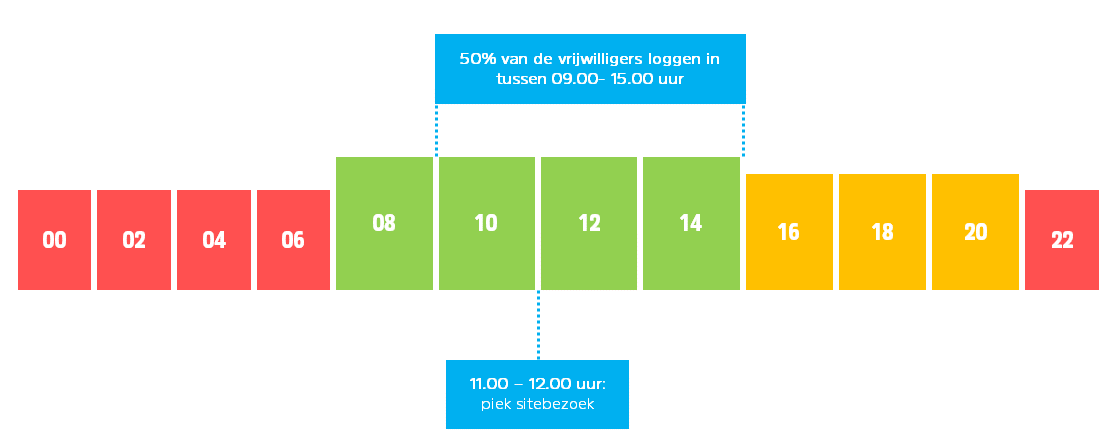
Best time: 10.00am – 12.00pm

Perhaps surprisingly, volunteers appear to log in primarily during office hours: 50% of volunteers log in between 09:00 and 15:00 . Website visits, not unexpectedly, show the same pattern. Around 11:00, we see a peak in both website visitors and logging-in volunteers; this is the 'peak' time. It is striking that we also see a small peak in website visits between 20:00 and 22:00, but that this peak does not result in volunteer activity (logging in).

NLvoorelkaar lists over 26.000 online requests for help. These requests are sorted by date by default. But note: it's not the date the vacancy was posted that counts, it's the date the person posting last logged in. This way, we know a vacancy is still current – ​​because nothing is more frustrating for a volunteer than finding out a vacancy has already been filled!

Additionally, the volunteer can of course apply their own search criteria: location, interest, frequency, etc. However, the list of vacancies is often long, so it is beneficial to be at the top. Therefore, ensure that your volunteer vacancy is online around 10:00 (or if it is already online: that you have logged in), so that the largest group of volunteers sees your vacancy.

Conversely, it is best not to post your volunteer vacancy after 3:00 PM and certainly not between 10:00 PM and 6:00 AM. There is a good chance that by the time the largest group of volunteers goes online to search, your volunteer vacancy will have already sunk down the list and will be seen less frequently or quickly.

Anchor: The best day

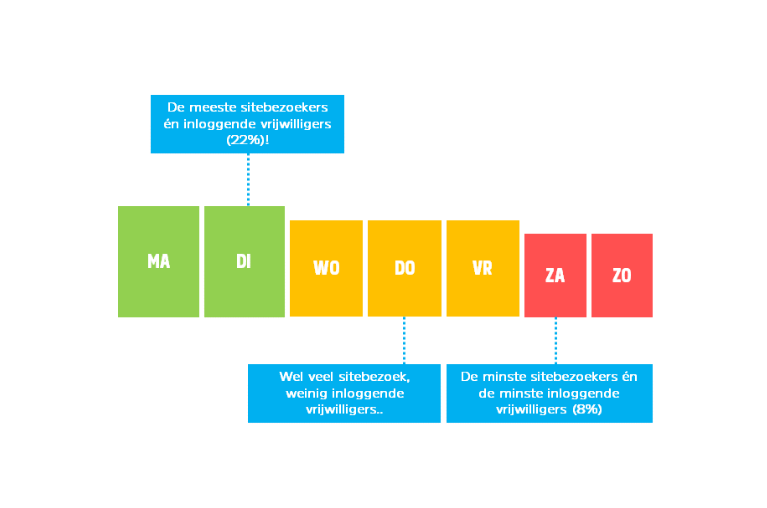
The best day of the week: Tuesday

Just as you start the new year with a good resolution, many people apparently also start the week with the intention of doing something good for others. These are the best days for volunteering (register and/or log in):

  1. Tuesday
  2. Monday
  3. Wednesday
  4. Thursday Friday
  5. Sunday
  6. Saturday

Monday and Tuesday are clearly the most popular days to look for volunteer work. Both website visits and volunteer activity show a peak on these weekdays. Tuesday appears to be slightly more action-oriented than Monday: although site visits are high on both days, the number of volunteers taking action on that day is highest on Tuesday. Over 22% of volunteers log in then, more than double the number on Saturday (9%)!

Preferably, do not post your volunteer vacancies on Saturdays . There are few site visitors and few active volunteers then. That is nice, because it allows you to enjoy the weekend yourself. Surprisingly, Thursday is not a top day either. For although site traffic is high then (highest after Monday and Tuesday) and a fair number of volunteers register, few volunteers log in on that day (comparable to Sunday: 12%).

The best month: autumn

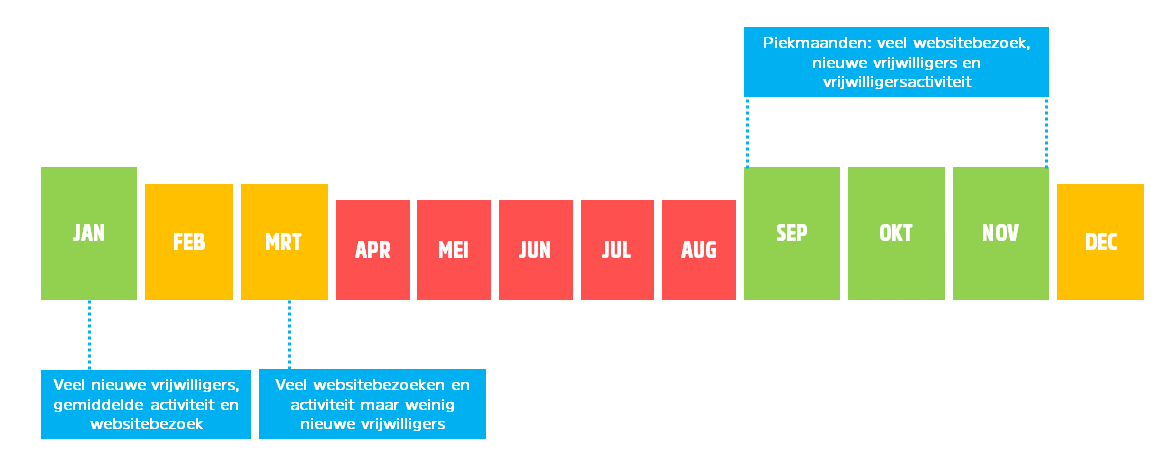
Autumn clearly proves to be the best time of the year to recruit new volunteers. The peak is in October: this month sees the most website visits, new volunteers, and the most volunteer activity. There is more website traffic in September than in November, but there is more volunteer activity in November than in September. An interpretation: volunteers explore volunteering opportunities in September and October and subsequently commit in October and November.

After the autumn, January is also an interesting month for recruiting volunteers. Not only are volunteers being recruited, but they're also actually signing up. New Year's resolutions are being put into practice!

Holidays are clearly not a favorite time to look for or start volunteering. June, July, and August, in particular, are below average on all fronts: 33% fewer volunteers register than in October, for example. The spring break and spring break are also not peak recruitment periods, with low volunteer registration rates. However, March is a positive exception, possibly due to events like NLdoet.

Does that mean you shouldn't do anything during those months? Absolutely not, because a 33% drop in volunteers in 2018 still meant almost 800 volunteers signed up. Add to that the other 35.000+ volunteers on NLvoorelkaar, and there are practically always potential volunteers who can work for you!


We hope this data will help you with your recruitment plan to inspire more volunteers to do something wonderful for those in need. Best of luck!

Want to know more?

Looking for the smartest and most engaging way to make a difference for your municipality or organization? Questions, ideas, a short demo, or exploring the possibilities together? Schedule a digital coffee with us!
Coffee plans →

The 10 best job vacancy tips to recruit new volunteers

Anchor: Blog
Width:

Sound familiar? You open a job board, read it, and after 10 seconds, you're so dizzy from the extensive job requirements, jargon, expectations, and promises that you can't (or don't want to) find the "apply" button. There are over 22.000 open positions in the volunteer sector – so it's even more important that you get potential volunteers curious and motivated to contact you. How do you avoid scaring off new volunteers? Avoiding buzzwords, jargon, and the job title goes a long way.

Reading time: 6 minutes

Labor market competition times ten

As passionate volunteer matchmakers, we see thousands of volunteer vacancies and requests every day. Literally: there are currently thousands of volunteer opportunities live. If you're looking for a helping hand (or other beautifully expressed parts of your body like a thoughtful mind or a warm heart), you're venturing into the most competitive market in the Netherlands. For comparison: in this thriving job market with more jobs than ever before, the larger job boards appear to have an average of around 2.500 vacancies. A tenfold difference compared to volunteer vacancies!

Anchor: Creativity required

Creativity required

So you'd think the creativity in recruiting volunteers would be overwhelming. How else are you going to stand out while scrolling through job postings? Or hold the reader's attention for more than three seconds? Otherwise, you won't even get a chance to tell them how you're making the world a little more beautiful...

But no—not really. Scrolling through the 22.000+ vacancies on NLvoorelkaar, you'll quickly conclude that creativity is hard to come by. Creativity, however, is requested over 1.200 times, so perhaps it's not surprising that it's a bit lacking right now ;-).

Scare


Besides a lack of creativity, some of the texts seem almost designed to avoid finding new volunteers. Generic texts and job posting numbers, jargon that makes you feel like an old man, and minimal participation requirements that require you to have no work or social life. Personality profile requirements aimed at the perfect person—which doesn't exist—thus scaring off the average person with their own lives and shortcomings. A shame. Because the whole point of a volunteer posting is to connect with each other. And then figure out together if you can make a difference.

The 10 best tips


For anyone looking for volunteers through a volunteer vacancy, we've compiled the 10 best tips. How do you stand out from the crowd? How do you find new volunteers to fill that fresh air? Read on and let us know your tips!

1. Title and photo

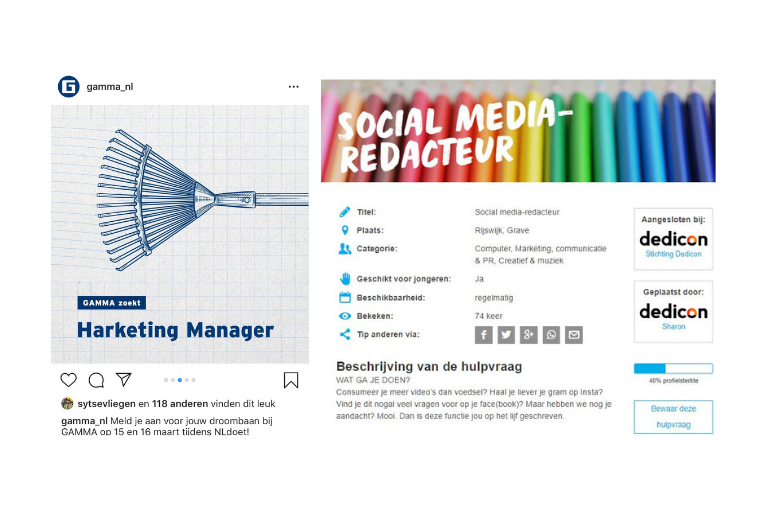
Create a concise, engaging title that makes readers want to keep reading. The title is often the only thing a job board or search engine displays. Our favorites: "Harketing Manager Wanted" or "Bus Driver Wanted" (source: Gamma for NLdoet).

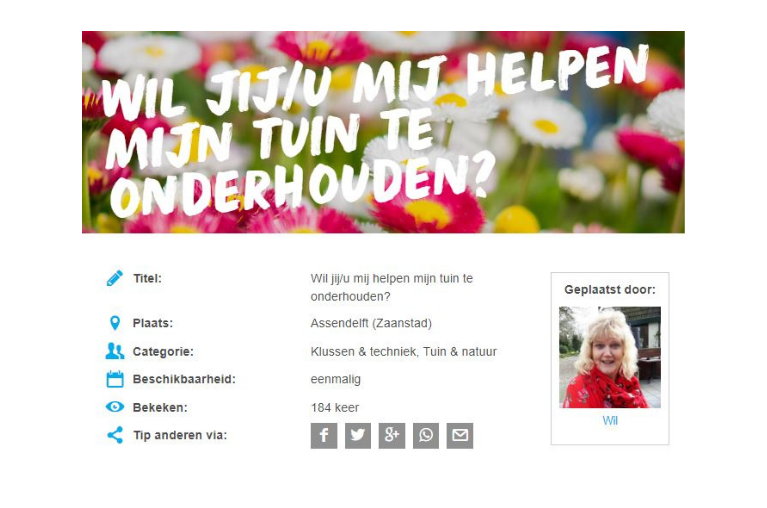
The same goes for photos. Yes, a logo is nice and easy and clear, but also rather boring. So dare to go for something personal, funny, or unique. Like this woman, whose great photo gets many more comments.

2. humor

A positive way to stand out is with humor. Think of the 'Harketing manager' instead of a gardener for your client. Or describe the activities with a wink, for example, 'Do you consume more videos than food, or do you find this too much on your face(book)?' ( Dedicon)

3. Avoid clichés

Are you also looking for a flexible, enterprising, enthusiastic, and communicative volunteer full of passion? Oops – there are about 10.311 (yes, really!) others like you. So you don't stand out.

And have you ever wondered what that does to the reader – the potential volunteer? When the word 'flexible' appears in a standard job description, everyone knows the employer is referring to overtime. I have never met a person who lacks communication skills (we can all talk and gesture), we prefer to do business *with* a financial reward, and passion is best kept for the bedroom. You can read more words you would rather not use in your volunteer vacancy here.

Prevent itching. Clearly explain what you expect from the other person. The easiest trick for this: pretend you're talking to a friend or family member!

4. Avoid jargon

This one is similar to the previous one: do you have an affinity for clients with moderate intellectual disabilities? Or are you more interested in mild intellectual disabilities? Vascular dementia? Autism spectrum disorder? Or experience with benzodiazepine withdrawal? These are just a few examples of the jargon used in the volunteer positions currently available.

Even with my master's degree in psychology, I'm tempted to click away screaming and enjoy... something else, anything. I already have a job, so I don't have time for scary illnesses (or looking up what that jargon actually means).

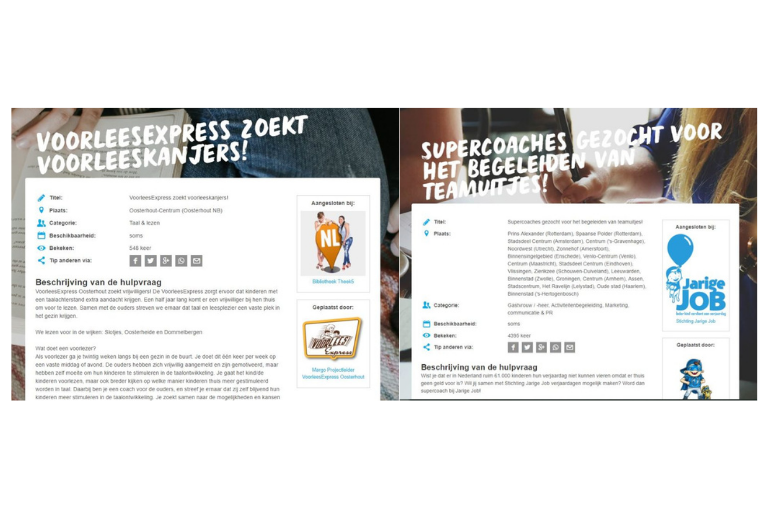
Top tip: keep it simple. And above all, human. Not a client, a patient with a serious illness, or Mrs. P looking for a free driver or gardener, but someone's grandpa/Ana who loves playing cards but can't roll over to her friend/Liv who, within two years, is almost fluent in Dutch/would be very happy if you helped out with... (fill in the blank). Good examples are the Jarige Job Foundation and the VoorleesExpress.

5. Mission

The mission (or impact – sorry for that buzzword) is often missing. Why would a volunteer sacrifice their valuable free time? It seems like a cliché, but it's forgotten in more than half of all texts!

Briefly mention the mission/impact at the top of your text. People read from top to bottom, and the first few lines of a volunteer posting are often shown in search results (on Google, NLvoorelkaar, etc.). Besides a statement (e.g., "Together we make sure every child can celebrate their birthday"), you can also consider impressive results (e.g., "Already helped 10.000 people"). Or keep it short with a meaningful quote about what the help has meant to someone.

6. Benefits: What's in it for them?

Write your recruitment text with a volunteer's perspective. What's in it for them? Better yet, ask a current volunteer. It'll instantly become more credible, because the WCeend team always considers WCeend the best and most fun.

Make sure your language, sentence structure, and offer are relevant to the volunteer you're looking for. Describe/ask/think about/Google the benefits of your volunteer work. Is walking with your seniors an impressive, mindful experience? Do you have the best coffee? The most friendly team? Or do you regularly laugh out loud at the tall tales or bold actions of your seniors? Share what you're proud of!

7. Demanding instead of asking politely

Job requirements is a word that belongs in regular job postings – and even evokes nostalgic 90s feelings in recruiters. And yet, it is currently used in 21% of volunteer vacancies (4.130 of them!). But the term 'volunteers' actually says it all. Requirements do not belong here.

So what? We challenge you to rethink: for example, go from requirement to ice cream... literally! That idea earned us 163 new volunteers for one vacancy. In this case, Ben & Jerry's actually provided ice cream, so it's definitely cheating a bit. But consider the talent everyone has and the time they're willing to donate to you. See if you click with someone and what makes them happy. You can probably find a creative outlet for that. And if not, your interviewer might know someone else. Recruiting through word of mouth is still the most successful recruitment method.

Would you like to have your free time committed to an unknown person, for an unknown purpose and with an unknown result for the coming year?

8. Short (enough)

Keep it short. Who has the time and inclination to wade through a whole A4 page of job descriptions, Certificates of Conduct (what? hello jargon!), compensation structures (only needed to know *that* they exist or not), volunteer contracts (yuck, mandatory!), or schedules? Job advertisements are a kind of elevator pitch: you have to be able to make someone wildly enthusiastic within a minute. Incidentally, that also means it shouldn't be too short; it's hard to get excited about something vague or unclear.

Once you've established contact, there's plenty of time to discuss preconditions and content. Think of applying for a job: you only discuss these kinds of things once you've met and clicked!

9. Non-binding and accessible

Whatever kind of amazing person you are, would you want to have your free time committed to an unknown person, for an unknown purpose, and with an unknown outcome for the coming year?

I don't. So make it easy to start doing something good. Of course, you want a volunteer who's there for four hours a week (or even more). But that kind of dedication has to grow. You have to like each other and both enjoy it. So offer introductory activities as well.

This can be very practical: an activity where you can always have extra people join you, in addition to your current volunteers. Or organize a meetup once a month where you can speed date with other volunteers and the coordinator. And think about a suitable time, because Tuesday morning might be easy for you, but for 60% of people, it's the busiest day of the week ;-).

Organizing differently also saves a lot of introductory meetings and is much more enjoyable. Because that's one of the main reasons people seem to volunteer (for example, research from NLvoorelkaar shows that 43% of volunteers want to meet new people).

10. Cherish

Finally: cherish and keep doing what works. Don't change for the sake of change. Cherish your volunteers. Share your positive experiences with others (like us) so we can continue to learn from each other. And perhaps you'd enjoy experimenting creatively with one of the tips in this article. A little variety and diversity is always refreshing, because if you do what you did, you get what you got.

Want to know more?

Looking for the smartest and most engaging way to make a difference for your municipality or organization? Questions, ideas, a short demo, or exploring the possibilities together? Schedule a digital coffee with us!
Coffee plans →

Vertalen »